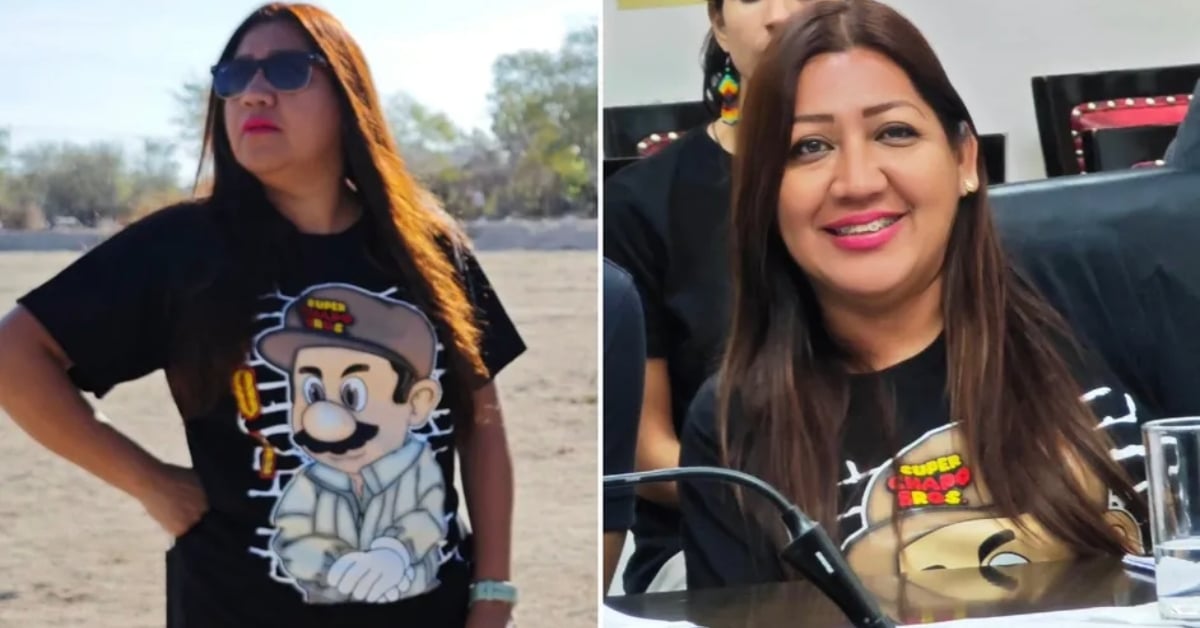
The La Paz councilwoman caused a stir when she attended a City Council work session wearing a T‑shirt emblazoned with Joaquín “El Chapo” Guzmán’s likeness. In the territory she represents—where rival cells of the Sinaloa Cartel are vying for control—her choice of attire took on a far more charged significance.
Councilwoman Mendoza of La Paz’s Ayuntamiento in Baja California Sur, stirred controversy this month when she appeared in a work meeting wearing a T‑shirt emblazoned with the likeness of Joaquín “El Chapo” Guzmán. Photographs shared on social media show Aguilar Mendoza inside the City Council Chambers donning a “Super Chapo Bros.” design—a playful mash‑up of the notorious Sinaloa Cartel leader and the classic Mario Bros. video game.
Local observers say the images raise serious questions about whether the councilwoman’s actions could amount to a criminal offense under Article 208 of the Federal Penal Code, which prohibits public provocation or glorification of crime. That provision mandates community service of ten to 180 days for anyone who “publicly provokes someone to commit a crime, or glorifies it or any vice,” even if no crime follows. Should a related offense occur, the instigator faces the full penalty for their role.
According to several posts circulating in July, the design on Aguilar Mendoza’s shirt replicates a photo of El Chapo taken in a U.S. maximum‑security prison, where he wears a sand‑colored jacket and cap. Over the years, this image has appeared on numerous souvenir items and apparel. However, wearing it at a government venue has struck many as an unusual—and potentially unlawful—gesture.
La Paz councilwoman Chapo T shirt controversy
In the council chamber photographs, other officials appear alongside Aguilar Mendoza, including Bernardo Montiel Ochoa (sixth council member), Karla Citlalith C. Ramírez (fifth council member), Sasha Ceseña Guillins (third council member), Félix Abraham Almendáriz Puppo (tenth council member), and trustee Yadane García Orozco Carrasco. Fifth councilor Karla Ramírez later posted on her official account: “Today we held a meeting with Esterito residents in the City Council Chambers to discuss the current situation on North Street,” noting the gathering was a routine public session.
To date, María del Carmen Aguilar Mendoza has not issued any public statement explaining her choice of attire or addressing concerns over Article 208. Political analysts suggest she may have underestimated the symbolic weight of displaying a T‑shirt that many see as praising one of Mexico’s most infamous criminals.
Local authorities in Baja California Sur report that rival cells linked to the Sinaloa Cartel are vying for control of the region. Since April, more than 40 narco‑banners have been seized, each accusing municipal and state officials of collusion with organized crime. In that tense context, a high‑profile local official appearing to trumpet El Chapo’s image could undermine confidence in public institutions.
Legal experts note that Article 208 applies regardless of intent. “The law does not require the person to incite violence directly,” explains criminal attorney Verónica Ruiz. “Publicly glorifying a convicted trafficker falls squarely within its scope.” If prosecutors choose to pursue the matter, Aguilar Mendoza could face mandated community service or, if linked to a subsequent crime, harsher penalties.
Residents of La Paz have reacted with a mix of disbelief and dismay. “It’s unbelievable that an elected official would wear that image while representing us,” said local business owner Ricardo López. “How can we trust decisions on public safety when our leaders appear to honor a drug lord?”
As the story unfolds, observers will watch for any formal response from the councilwoman or action by the state prosecutor’s office. For now, Aguilar Mendoza’s T‑shirt choice remains a focal point in a city already grappling with narco‑related tensions and questions over official integrity.
La Paz news, Baja California Sur, El Chapo, Joaquín Guzmán, politics, Federal Penal Code, Article 208, councilwoman, organized crime